Showing posts with label Otis Redding. Show all posts

Saturday, May 30, 2009

Big Mike: This Means War

I was on the phone with my esteemed colleague, the renowned author Benny Jay, the other day. Somehow the conversation got around to the first concert I'd ever attended. I told him that I'd seen Parliament and War at the International Amphitheater in 1973. There was silence for a moment, then Benny Jay launched into hosannas about my coolness that led me to believe if we'd have been in the same room, he'd have begun salaaming me.

Now, Benny Jay is as wired in to the Brother Culture about as much as any white man ever has been. I assumed he'd been in the groove from childhood on. Sadly, he wasn't. Benny Jay later admitted that way back in 1973, he was still listening to Top 40 songs on WLS and WCFL.

In the 60s, these two seminal Chicago rock 'n' roll radio stations had introduced me to Sam Cooke, Otis Redding, Jackie Wilson and the Chambers Brothers as well as blue-eyed soul brothers like the Rolling Stones, Tommy James and the Shondells, the Young Rascals and others. I still listen to all of them to this day. But by 1973, the two radio titans had grown stale, reflecting the state of pop music at the time, and my radio dial never again came near either AM 890 or 1000. I refused to listen to the unbearable crap they were playing. To illustrate, here's a list of some of the top songs of 1973. Read it and try to refrain from retching:

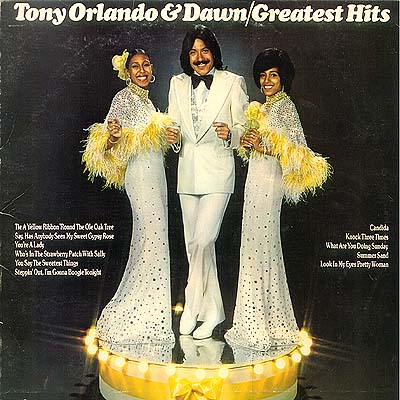
  • "Tie A Yellow Ribbon 'Round The Old Oak Tree," by Tony Orlando and Dawn
  • "The Night The Lights Went Out In Georgia," by Vickie Lawrence
  • "Little Willy," by Sweet
  • "Half Breed," by Cher
  • "Wildflower," by Skylark
  • "The Morning After," by Maureen McGovern
  • "Diamond Girl," by Seals and Crofts
  • "Boogie Woogie Bugle Boy," by Bette Midler
  • "Funny Face," by Donna Fargo
  • "The Twelth Of Never," by Donny Osmond

And some people think waterboarding is torture. Poor Benny. He says it wasn't until he went away to college that his musical horizons broadened. He became infatuated with Jimi Hendrix, among many others. Now, I can take Jimi Hendrix or leave him (well, to tell the truth, I'll leave him, period) but that's a matter of taste. At least he turned a youthful Benny Jay away from Tony Orlando and Dawn.

Our conversation got back to that first concert I'd attended. My pal Whitey and I took the No. 72 North Avenue bus from its western terminus at Narragansett Avenue seven miles east to Halsted Street, where we picked up the No. 8 bus and headed south another 57 blocks to Bridgeport and the Amphitheater. The ride took a good two-and-a-half hours but we both loved War. The song, "The World Is A Ghetto," was a brilliant, haunting, 10-minute-long masterpiece. Whenever it came on the radio (by this time, I'd become an habitual WGLD listener - the low-watt Oak Park station that later gave way to WXRT) I became lost in it, cranking the volume up to Nigel Tufnel's mythical 11. A bomb could have gone off next to me but I'd take no notice.

Neither Whitey nor I were familiar with Parliament but by the time its opening set was finished, we'd become diehard fans. Since we were a couple of half-broke Northwest Side teenagers, we could only afford cheap seats. We sat somewhere near the upper boundary of the troposphere and viewed the proceedings through a dense haze of legal and illegal smoke. We got back home to Galewood around 4:00am, proud of ourselves for our sojourn into the big, black inner city.

"How many white people do you think there were at the Amphitheater that night?" Benny asked.

"I'd say two - Whitey and me," I replied.

"So, you were the only two white guys in the whole place, and one of you is named Whitey!" Benny exclaimed, roaring. Then, he added a correction. "Three white guys - you forgot War's harmonica player, Lee Oskar."

I congratulated Benny Jay on his knowledge of War. Thank the gods, dumb luck or modern pharmacology, his listening to Donny Osmond hasn't resulted in brain damage.

Saturday, March 14, 2009

Benny Jay: The Keys On Richard's Chain

I get up early to go to Richard Pegue's funeral. I figure I have no choice since I expect half the town's gonna be there.

I take Lake Shore Drive, heading south. Traffic's heavy on the north side, but south of the Loop, it picks up.

The service is at Apostolic Church of God, the mega-church at the corner of 63rd and Dorchester Avenue.

I sign the guest book and take a seat in the back of the sanctuary. Must be over 1,500 people there with more coming in. Almost every one's black. Can't say I'm surprised. For over 40 years, Richard, a disc jockey, played R & B and soul, the kind of music everybody loves. But he played it on WVON and other black stations. And you know how it goes in the Chi. Whites here, blacks there. Might as well live on different galaxies in space. Ask black baby boomers if they've heard of Richard and they'll say -- "Are you crazy? I grew up listening to that man." But most white guys -- they don't even know the name.

The church organ's playing soft, sorrowful chords of mourning. Up on the stage, Pam Morris, the mistress of ceremony, runs through the speakers.

I think back to when I met Richard -- must have been a dozen years ago. I wrote an article about him. After that we'd meet every now and then at a diner -- a smoky, cab driver's joint -- a little west of the Hancock. Richard would roll in after dropping off his wife at work. He carried his cell phone in one hand and a big clump of keys in the other. More than once I asked him what's with the keys? But he never gave me a straight answer. Richard liked his secrets. He joked about having an alter ego -- Willie the Janitor, the black guy no one pays attention to, even though he secretly owns properties all over town. He'd talk in riddles, like a character in a song by Bob Dylan. I'd ask him head on -- what are you getting at? And he'd smile and let it go at that. Half the time I didn't know what he was driving at. Thought I knew but I wasn't sure.

I scan the church, looking for familiar faces. I recognize a few from the diner. Richard was always bringing folks together. He'd call me up and say there's someone you should meet. So I'd go to the diner and meet one of his guys. There was his Computer Guy, his T-shirt Guy, the guy who sold him fresh-baked cookies. I was his Writer Guy. I'd tell Richard that me and the others were like the keys on his chain -- we unlocked different parts of his life. He liked that metaphor. He'd smile his elusive Richard smile and tell me we had to write a book. I'd tell him, if we're gonna write a book, he'd have to give me something good to write about. He'd just smile some more and say he'd tell me all I needed to knew when the time was right to tell me.

The service moves quickly. Richard Steele, Richard's oldest friend, talks about how they formed a doo-wop group -- in order to pick up girls -- almost 50 years ago, when they were students at Hirsch High School. Jackie Taylor introduces Melanie McCullough and Theo Huff, two singers from her company, The Black Ensemble Theater. McCullough sings "At Last" and Huff sings "Try a Little Tenderness," one of my all-time favorites. I love that song every time I hear it even though I've heard it many times before. Huff sings it strong, sounds just like Otis Redding. Almost makes me forget I'm at a funeral.

After the service, I head back north along the Drive. I scan the radio look for "Try A Little Tenderness." But all I hear is commercials, so I turn off the radio and let the memory of the song linger in my mind as I drive by Soldier Field and the Museum Campus, returning to the white side of town....

Two days later I get a call. The voice on the phone says she's Stephanie, daughter of Helena Appleton. I can't believe it. Helena and I worked together over 25 years ago. I loved Helena. She treated me like a son. I used to help her fetch her groceries at the Stop `n Shop on Randolph Street. We'd be walking through the Loop and she'd give me all the gossip. Stephanie and I try to recall when we last saw each other. Must have been in 1987 -- at her mother's funeral.

Anyway, Stephanie read a tribute I wrote to Richard and decided she had to call. Turns out she knew Richard for over 30 years -- used to do voice-over work for him back in the `70s.

We swap stories about Richard, fill each other in on the last twenty years of our lives, exchange email addresses, and promise to do a better job of staying in touch.

I hang up the phone and look out the window at a squirrel running across the telephone wire in the alley. All those years of meeting Richard at the diner and we never made the Helena connection. Who would have thought that Helena's daughter was another key on Richard's chain? Guess I shouldn't be surprised. Like I told you, the man knew half the people in this town.